

How to Compare Colleges After Campus Visits Without Losing Your Mind
Aug 04, 2026
Written by Kathy LePage, PhD, Certified School Psychologist & Educational Consultant — Helping families make thoughtful educational decisions with clarity and calm.
Quick answer: To compare colleges after campus visits, track the same categories for every school: academics, cost, campus life, support, and gut feeling. Capture notes the same day so schools do not blur together.
Comparing colleges after campus visits needs a simple system, not just a good memory.
This is the fourth post in FutureU’s College Visit Series. In the first three posts, we covered when to start visiting colleges, the most common mistakes families make, and questions to ask on a visit. Now we’re focusing on how to compare colleges so you can be less stressed and more confident in your decisions.
Also in this series:
- When Should You Start Visiting Colleges
- 3 College Visit Mistakes Families Make and How to Avoid Them
- 20 Questions to Ask on a College Visit: Parent and Student Lists
- What to Do After a College Visit: 5-Minute Checklist
- What Will College Actually Cost? How to Compare Your Real Cost, Not the Sticker Price
By the third campus, they start to blend. Was the dining hall you liked at School A or School B? Which one had the professor your student actually talked to for ten minutes? Which had the smaller class sizes — or did you just assume that one because of the brochure?
This isn't a sign you're doing college visits wrong. It's a sign you're doing them the way most families do — without a system. And a system is the whole fix.
The "Blur" Is Real — and It's Not About Willpower
You are not going to out-remember five campus visits in three weeks. Nobody can. The answer isn't trying harder to pay attention on the tour. It's capturing what you noticed before it fades — the same day, in the same format, every time.
Comparing on gut feeling isn't the problem, either. Gut feeling is real information. The problem is when it's not written down anywhere, so by decision time, it's gone — replaced by whichever school you happen to remember most vividly, which is often just whichever one you visited last.
A Simple System: 4 Steps
- Pick your categories before you visit — not after. Size, location, academics, cost, campus life, and support are a solid starting set. Decide them once, use them for every school.
- Rate your gut feeling the same day, before you leave the parking lot. A 1–10 scale is enough. Don't overthink it.
- Capture three things you liked and one thing that gave you pause. Specific, not vague — "the CS building had open study rooms at 9pm," not "it felt nice."
- Compare as a family only after every visit is done. Comparing after each individual visit invites recency bias — the most recent school always feels like the frontrunner. Wait until you have the full picture.
Think of this process as creating a simple college comparison checklist: the same categories, the same format, and the same timing after every visit.
If you’re still early in the visit process, the free Parent + Student College Visit Guides can help you notice what matters before you start comparing schools side by side.
What a Comparison Actually Looks Like
The goal is not to rank every school perfectly. It’s to make the same details visible across each option.
Here’s what a simple college comparison system can look like. It does not need to be complicated. It just needs to be consistent.
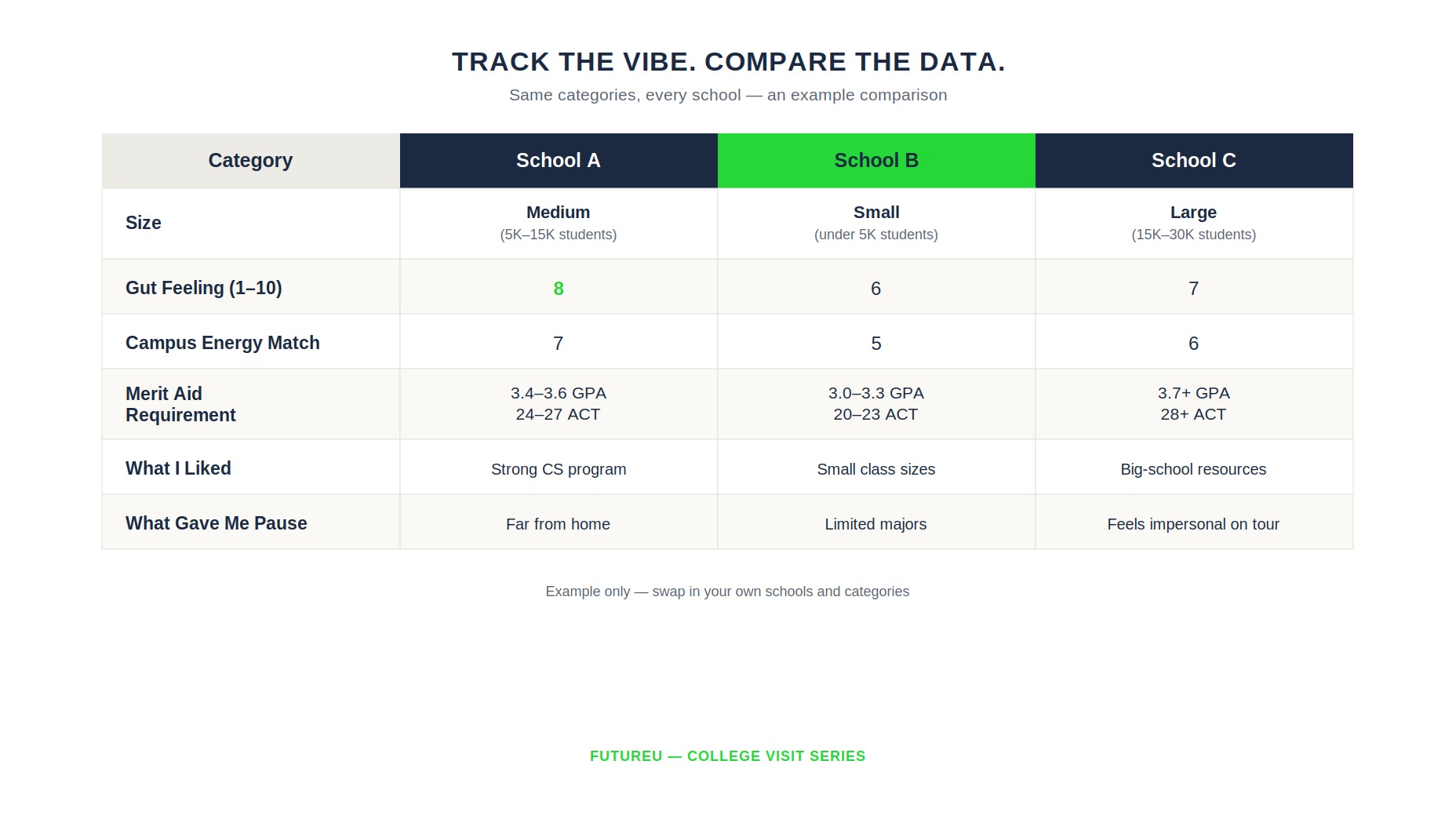
Once each visit is done, write down your gut feeling — before any of it fades. Try to leave out the weather, how interesting the tour guide was, or how tired you were that day and make it about how the place felt. What's your initial reaction? Is the energy level a good match for you?
This isn't a ranking system that spits out a winner. It's a decision-support tool. Once it's in front of you, your gut still gets a vote — but now it's an informed one, not a foggy one.
If you’re still deciding what to ask while you’re on campus, start with the parent and student question lists from the previous post.
Before your next visit, choose five categories you’ll use for every school: academics, cost, campus life, support, and gut feeling. After each visit, fill them in the same day.
This Isn't About Efficiency for Its Own Sake
A comparison system isn't about squeezing the feeling out of the process. It's the opposite — it protects the feeling. When the logistics are handled (the categories, the notes, the numbers), your family actually has the bandwidth to talk about how a place felt, instead of spending that conversation trying to remember which school had which dining hall.
The goal is not to force a perfect decision from a spreadsheet. The goal is to give your family enough structure to have a calmer, more honest conversation.
Where to Start
If you’re comparing a few schools:
College Visit Kit Essentials for families comparing a few schools and wanting a simple side-by-side tracker.
If you want a more complete planning system:
College Visit Kit Pro for families who also need to compare cost, aid, loans, and long-term affordability.
If your family wants help talking through the comparison, either before or after visits, a College Visit Planning Session is available for more guided support.
When comparison raises bigger questions
Sometimes comparing colleges brings up more than a favorite campus. It raises questions about affordability, course selection, testing, applications, independence, support needs, and whether a school is truly the right fit.
That’s where FutureU Academy fits. It’s for families who want a calmer, more guided path through the broader college planning process, not just a one-time comparison tool.
Frequently Asked Questions
What is the best way to compare colleges after visits?
The best way to compare colleges after visits is to track the same categories for every school, including academics, cost, campus life, student support, and gut feeling, then review them side by side after all visits are complete.
What should be included in a college comparison checklist?
A college comparison checklist should include size, location, academics, cost, campus life, student support, visit impressions, and any concerns that came up during or after the visit.
How do you keep college visits from blending together?
Write down your gut feeling, three things you liked, and one concern the same day as each visit. Waiting even a few days makes the schools harder to compare clearly.
How many colleges should you visit before deciding?
There's no fixed number — three to six is common for many families. What matters more than the count is having a consistent way to compare whatever number you do visit.
A comparison system shouldn't make the decision feel colder. It should make the conversation calmer. When your family can see the details clearly, you have more room for honest conversations that lead to good decisions.
Full College Visit Series
This post is part of FutureU’s College Visit Series, designed to help families plan campus visits with more clarity and less stress.
- When Should You Start Visiting Colleges? A Grade-by-Grade Guide
- 3 College Visit Mistakes Families Make and How to Avoid Them
- 20 Questions to Ask on a College Visit: Parent and Student Lists
- What to Do After a College Visit: A 5-Minute Checklist
- How to Compare Colleges After Campus Visits Without Losing Your Mind (You’re here)
- What Will College Actually Cost? How to Calculate Your Real Cost, Not the Sticker Price
Explore the full College Visit Planning Guide
Kathy LePage, PhD, is a Certified School Psychologist and Educational Consultant who helps families navigate big educational decisions with more clarity, confidence, and less stress. She supports families with college planning, educational and therapeutic placement, and support options for children, adolescents, and young adults — including building the real-world skills needed to live as independently as possible.
Get FutureU college planning updates
Practical tips for teens, parents, and educators on college, careers, and life after high school - plus updates on FutureU resources - delivered straight to your inbox.
We hate SPAM. We will never sell your information, for any reason.