
What Will College Actually Cost? How to Calculate Your Real Cost, Not the Sticker Price
Aug 11, 2026
Written by Kathy LePage, PhD, Certified School Psychologist & Educational Consultant — Helping families make thoughtful educational decisions with clarity and calm.
Quick answer: The real cost of college is the total amount your family is likely to pay after grants, scholarships, and aid, projected across all four years. It is not the sticker price.
To calculate the real cost, subtract expected aid from the total cost of attendance to get your net cost, then project that number across four years using a realistic annual tuition increase rate — 2.9% to 4.0% at most schools in 2025-26, per College Board — not just the Year 1 sticker price.
This is the fifth post in FutureU’s College Visit Series. In the first posts, we covered when to start visiting colleges, the most common mistakes families make, questions to ask on a visit, and how to compare colleges. Now we’re focusing on the number that matters most: what college will actually cost your family over four years.
Also in this series:
- When Should You Start Visiting Colleges
- 3 College Visit Mistakes Families Make and How to Avoid Them
- 20 Questions to Ask on a College Visit: Parent and Student Lists
- What to Do After a College Visit: 5-Minute Checklist
- How to Compare Colleges After Campus Visits Without Losing Your Mind
Video summary: sticker price, net cost, and four-year cost
In the video above, Kathy LePage explains why families should not make college decisions from the sticker price alone. The better number is the family’s real cost: total cost of attendance minus expected grants, scholarships, and aid, projected across all four years.
- Sticker price is the published cost before aid.
- Net cost is what your family may actually pay after grants, scholarships, and aid.
- Four-year cost is the number families should use when comparing colleges.
Sticker-price panic is common — a school's listed cost of attendance shows up and the whole family reacts to a number almost nobody actually pays. But the opposite mistake is just as common, and more expensive: assuming financial aid will "work out" and not running any numbers until the acceptance letter — or the bill — arrives.
The number that actually predicts whether a school is affordable for your family isn't the sticker price. It's the net cost, projected over four years. Here's how to get there.
How to Calculate the Real Cost of College
Total Cost of Attendance − Expected Aid = Net Cost
Total cost of attendance includes tuition and fees, room and board, books and lab fees, and personal expenses — everything, not just tuition. Expected aid includes merit scholarships, need-based grants, and any outside scholarships you already know about. What's left is your real, current-year number. While final tuition numbers often aren't announced until summer, it's worth getting the best estimate you can, early, so you can actually compare costs across the schools on your list.
How to calculate your real college cost
- Find the school’s total cost of attendance.
- Subtract expected grants, scholarships, and aid.
- Estimate annual tuition increases over four years.
- Run a loan payment estimate if borrowing is part of the plan.
Then — and this is the step almost everyone skips — project it forward and estimate loan payments, if borrowing is part of your plan.
If you are still planning visits, this is why the merit aid question belongs on your campus visit list — 20 Questions to Ask on a College Visit: Parent and Student Lists.
Quick tip — Using college net price calculators
College net price calculators can be useful starting points, but they are only estimates. Use them to compare schools early, then update the numbers when actual aid offers arrive.
What counts as expected aid?
Expected aid usually includes merit scholarships, need-based grants, and outside scholarships. Loans can help cover the gap, but they are not the same as aid because they must be repaid.
Why Year 1 Isn't the Number That Matters
According to College Board’s Trends in College Pricing and Student Aid 2025 report, published tuition and fees for 2025–26 increased 2.9% at public four-year in-state institutions and 4.0% at private nonprofit four-year colleges. That means a Year 1 estimate is only a starting point. Families need to project cost across all four years. A school that looks like the cheaper option in Year 1 can look very different by Year 4 once an increase like that compounds — especially if the more expensive school locked in a tuition guarantee and the "cheaper" one didn't. (College Board, Trends in College Pricing and Student Aid 2025, Figures CP-9 and CP-10)
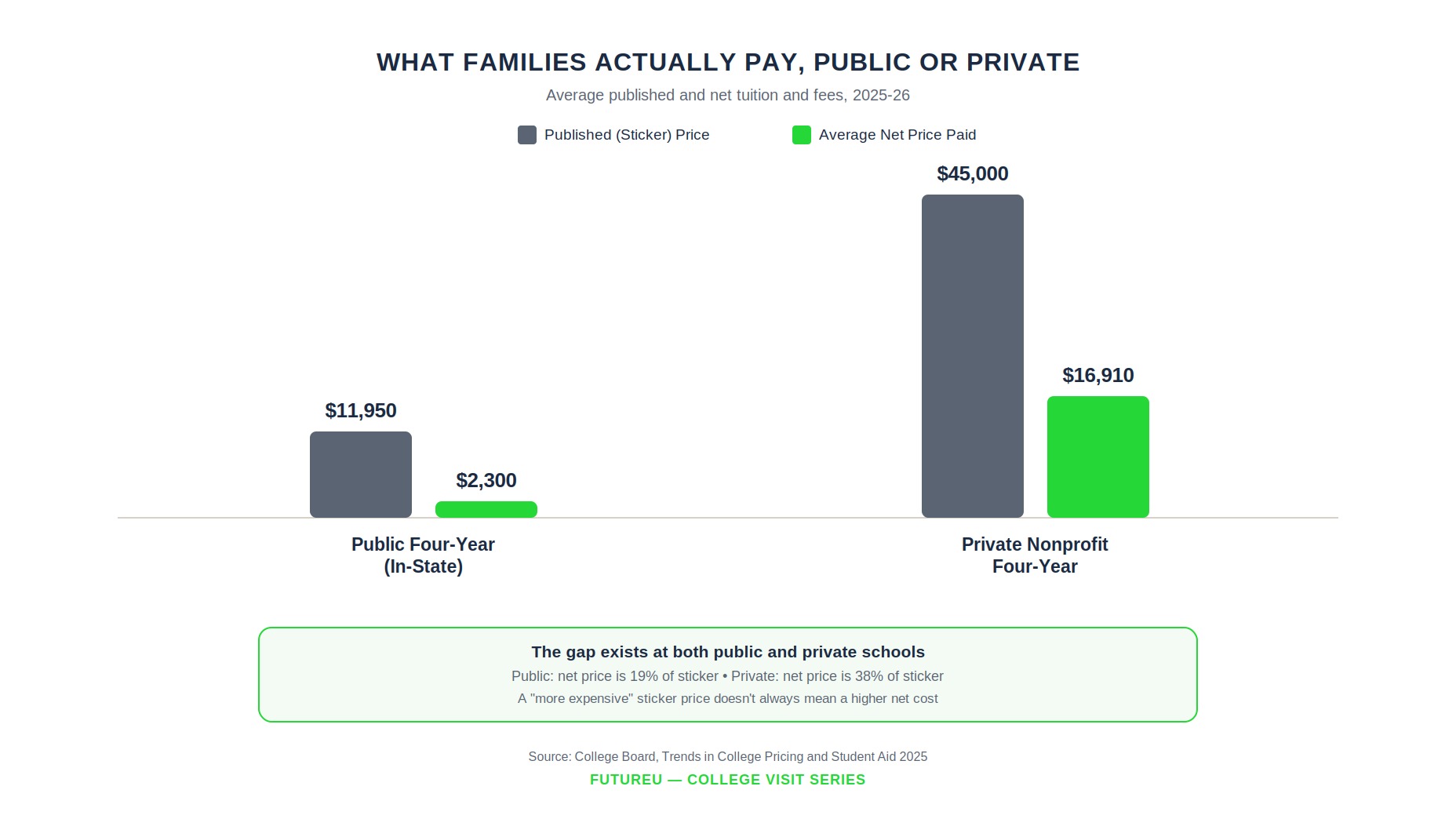
Worth knowing too: sticker price and net price can be very different numbers — at both kinds of school. The same College Board report estimates that in 2025-26, families at public four-year colleges paid an average net price of just $2,300 against a $11,950 sticker price. Families at private nonprofit colleges paid an average of $16,910 against a $45,000 sticker price. Different scale, same pattern: the number on the brochure isn't the number most families actually pay. This is exactly why the "ask about merit aid" question matters as much as it does.
A Worked Example
Say a school's net cost in Year 1 comes out to $22,000. Here's what that looks like projected out using the 4.0% one-year increase private nonprofit four-year colleges saw in 2025-26, per College Board:
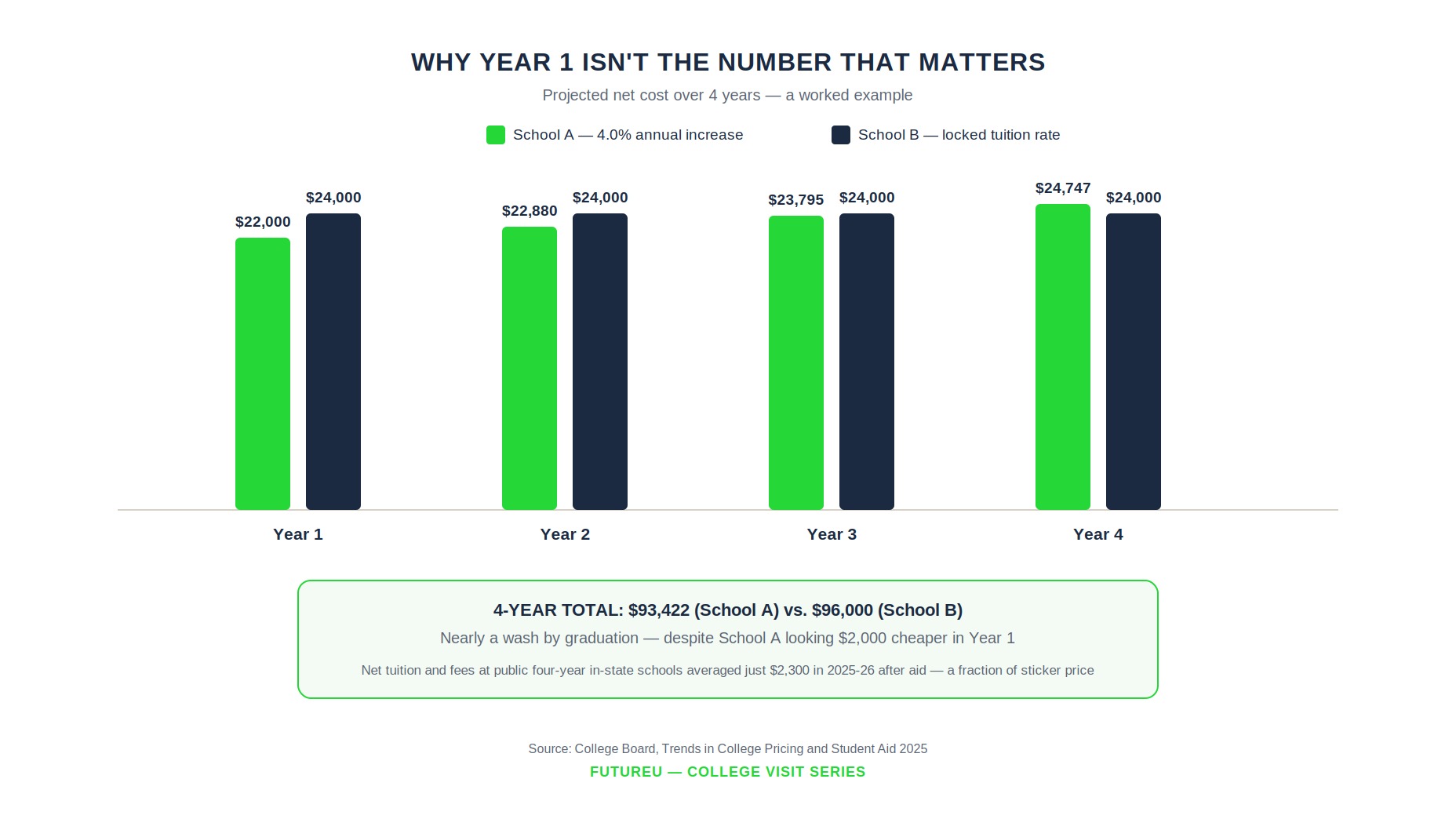
Compare that to a school with a slightly higher Year 1 net cost of $24,000 but a locked tuition rate (0% increase): $96,000 over four years. Suddenly the "more expensive" school in Year 1 is nearly a wash by graduation — a comparison you'd never see if you only looked at the first number.
Net Prices Have Actually Been Falling
Here's something that runs against the headlines: after adjusting for inflation, average net prices have declined over the past decade — at both public and private four-year colleges. Public four-year net price peaked in 2012-13 at $4,450 and has fallen to $2,300 today, a 48% drop. Private nonprofit net price has fallen from $19,810 in 2006-07 to $16,910 now.
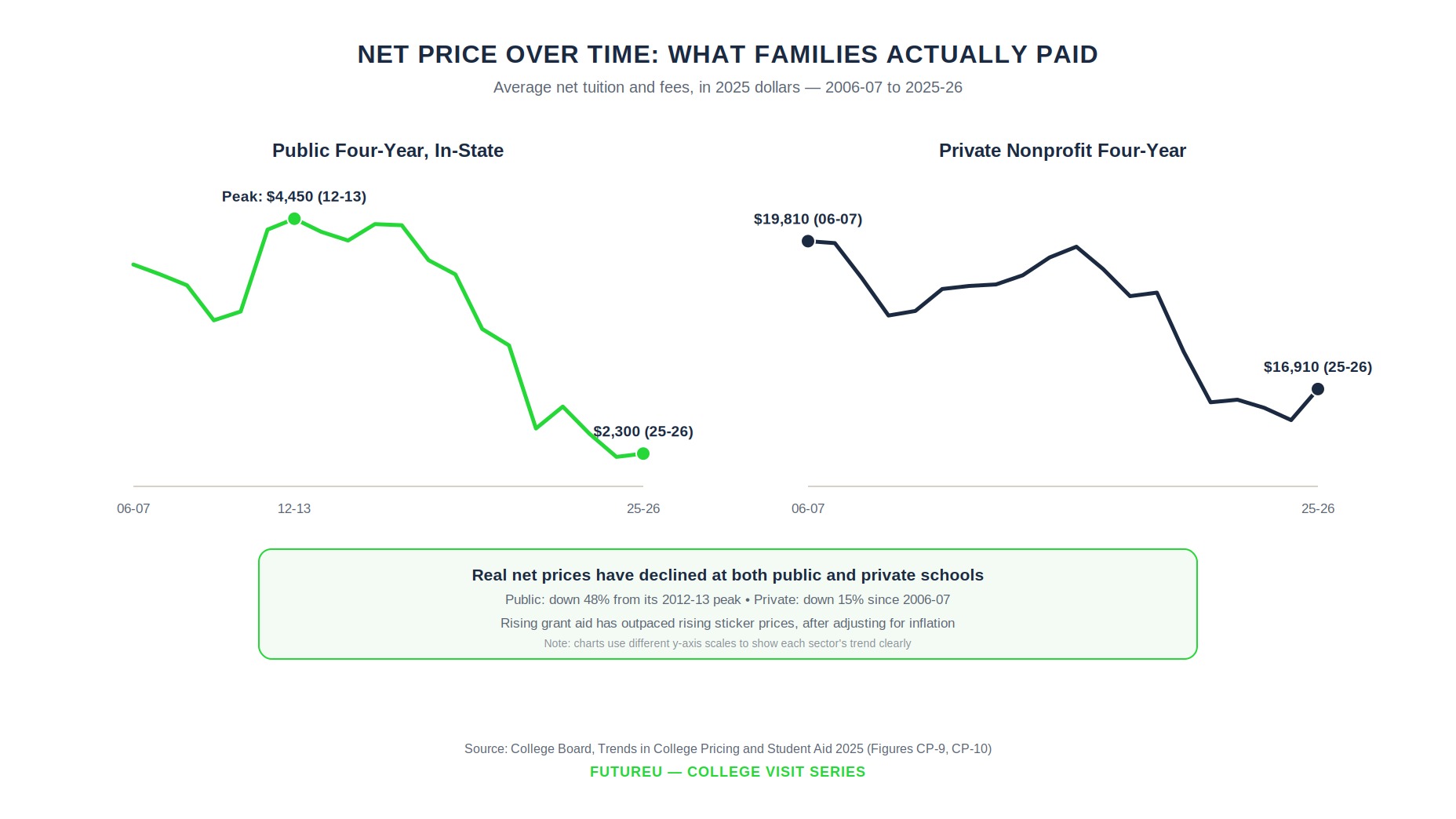
This doesn't mean college feels cheaper — sticker prices and total budgets have both grown over the same period. But it does mean grant aid has grown faster than published prices, which is exactly why net price, not sticker price, is the number worth tracking school to school.
The Loan Reality Check
Once you know your net cost, the next question is: how much of that gap gets covered by savings, current income, or loans? If loans are part of the plan, run the actual numbers before enrollment, not after.
A rough way to think about it: take the total amount you expect to borrow over four years, and estimate a standard 10-year repayment at a typical federal or private loan rate. That monthly payment is the number that follows your student into their twenties — it's worth knowing now, not in May of senior year.
This Isn't About Talking Anyone Out of a Dream School
Running these numbers isn't about steering your student away from the school they love. It's about making sure nobody's blindsided in April, after the excitement of an acceptance letter has already set expectations. A school can absolutely be worth stretching for — that's a real, valid family decision. It should just be a decision made with the real number in front of you, not the sticker price.
Instead of avoiding the money conversation until the acceptance letters are in → Try scheduling it as its own family conversation, early, before anyone's fallen in love with a place they haven't priced out yet.
Doing the Math for More Than One School
Running this calculation once is doable with a calculator and ten minutes. Running it for four or five schools — and remembering which assumptions you used for which school — is where most families give up and go back to comparing sticker prices out of exhaustion.
If you want a calmer way to compare several schools, the Financial Aid tab inside the FutureU College Visit Kit Pro lets you enter costs and aid once, then compare projected four-year totals side by side. It's designed for families who want to understand cost, aid, loans, and long-term affordability before making a decision. This is most useful if your family is comparing several schools, weighing merit aid, or trying to understand whether loans would create too much strain after graduation.
If you also want to talk through your numbers with a person, that's exactly why a College Visit Planning Session is available with the Pro Kit.
If you only need a simple visit comparison tracker, Essentials may be enough. If cost, aid, and loans are part of the decision, Pro is the better fit.
Before you get to the money conversation, it helps to have already asked the right questions on the visit itself — the merit aid question especially. For a reminder, review post #3 in this series — 20 Questions to Ask on a College Visit: Parent and Student Lists
When Comparison Raises Bigger Questions
Sometimes comparing college costs brings up lots of questions, not just about affordability, but also about course selection, testing, applications, independence, support needs, and whether a school is truly the right fit.
That’s where FutureU Academy fits. It’s for families who want a calmer, more guided path through the broader college planning process that goes beyond a college visit tool.
Frequently Asked Questions
What is the difference between sticker price and net cost for college?
Sticker price is the full, published cost of attendance before any aid. Net cost is what your family actually pays after subtracting merit scholarships, need-based grants, and other aid — it's almost always lower, sometimes significantly.
What is a college net price calculator?
A college net price calculator is an online tool that estimates what your family may pay after grants and scholarships. It can help with early comparisons, but the final number comes from the school’s actual aid offer.
Do student loans count as financial aid?
Loans may be included in a financial aid offer, but they are not the same as grants or scholarships because they have to be repaid. When comparing colleges, separate free money from borrowed money.
How much does college tuition increase each year on average?
According to College Board's Trends in College Pricing and Student Aid 2025 report, published tuition and fees rose 2.9% at public four-year in-state institutions and 4.0% at private nonprofit four-year colleges for 2025-26. Increases vary by institution and year, which is why a four-year projection matters more than the Year 1 number alone. (Full report)
Is private college always more expensive than public college after financial aid?
Not necessarily by the same margin as sticker price suggests. Private nonprofit colleges have a much larger gap between sticker and net price (paying roughly 38% of sticker on average) than public colleges (roughly 19%), so the sticker-price gap between a public and private school often shrinks — sometimes significantly — once real aid is factored in.
How do I estimate the total four-year cost of college?
Start with the first-year net cost, then apply a realistic annual increase for tuition and fees each year. Add all four years together, then estimate any loan payments if borrowing is part of the plan.
How do you calculate a college loan payment before enrolling?
Estimate the total amount you expect to borrow across four years, then calculate a standard repayment (commonly 10 years) at a typical loan rate to see the monthly payment. Doing this before enrollment — not after — lets you compare it against your family's actual budget.
The goal is not to make college decisions feel colder. It is to make them clearer. When your family can see the real number, you can have a calmer conversation about what is possible, what is worth stretching for, and what would create too much strain.
Full College Visit Series
This post is part of FutureU’s College Visit Series, designed to help families plan campus visits with more clarity and less stress.
- When Should You Start Visiting Colleges? A Grade-by-Grade Guide
- 3 College Visit Mistakes Families Make and How to Avoid Them
- 20 Questions to Ask on a College Visit: Parent and Student Lists
- What to Do After a College Visit: A 5-Minute Checklist
- How to Compare Colleges After Campus Visits Without Losing Your Mind
- What Will College Actually Cost? How to Calculate Your Real Cost, Not the Sticker Price (You’re here)
Explore the full College Visit Planning Guide
Kathy LePage, PhD, is a Certified School Psychologist and Educational Consultant who helps families navigate big educational decisions with more clarity, confidence, and less stress. She supports families with college planning, educational and therapeutic placement, and support options for children, adolescents, and young adults — including building the real-world skills needed to live as independently as possible.
Get FutureU college planning updates
Practical tips for teens, parents, and educators on college, careers, and life after high school - plus updates on FutureU resources - delivered straight to your inbox.
We hate SPAM. We will never sell your information, for any reason.