
When Should You Start Visiting Colleges? A Grade-by-Grade Guide
Jul 15, 2026
Written by Kathy LePage, PhD, Certified School Psychologist & Educational Consultant — Helping families make thoughtful educational decisions with clarity and calm.
Quick answer: Most families should start informal college visits in 10th grade, take serious tour-and-info-session visits in 11th grade, and use senior year for final revisits and decision-making — not a first look.
This is the first post in FutureU’s College Visit Series. We’ll start with when to visit, then move into how to make each visit more useful, what questions to ask, how to compare schools afterward, and how to think clearly about cost.
Also in this series:
- 3 College Visit Mistakes Families Make and How to Avoid Them
- 20 Questions to Ask on a College Visit: Parent and Student Lists
- What to Do After a College Visit: 5-Minute Checklist
- How to Compare Colleges After Campus Visits Without Losing Your Mind
- What Will College Actually Cost? How to Compare Your Real Cost, Not the Sticker Price
There's a version of this question hiding under a lot of others:
"Are we behind?"
"Is it too early to start?"
"Should we have already been doing this?"
Here's the short answer:
College planning doesn't start senior year. That's when it ends.
What starts earlier isn't stress — it's exposure. Low-stakes, no-pressure exposure to what different kinds of schools actually feel like, long before any application is due.
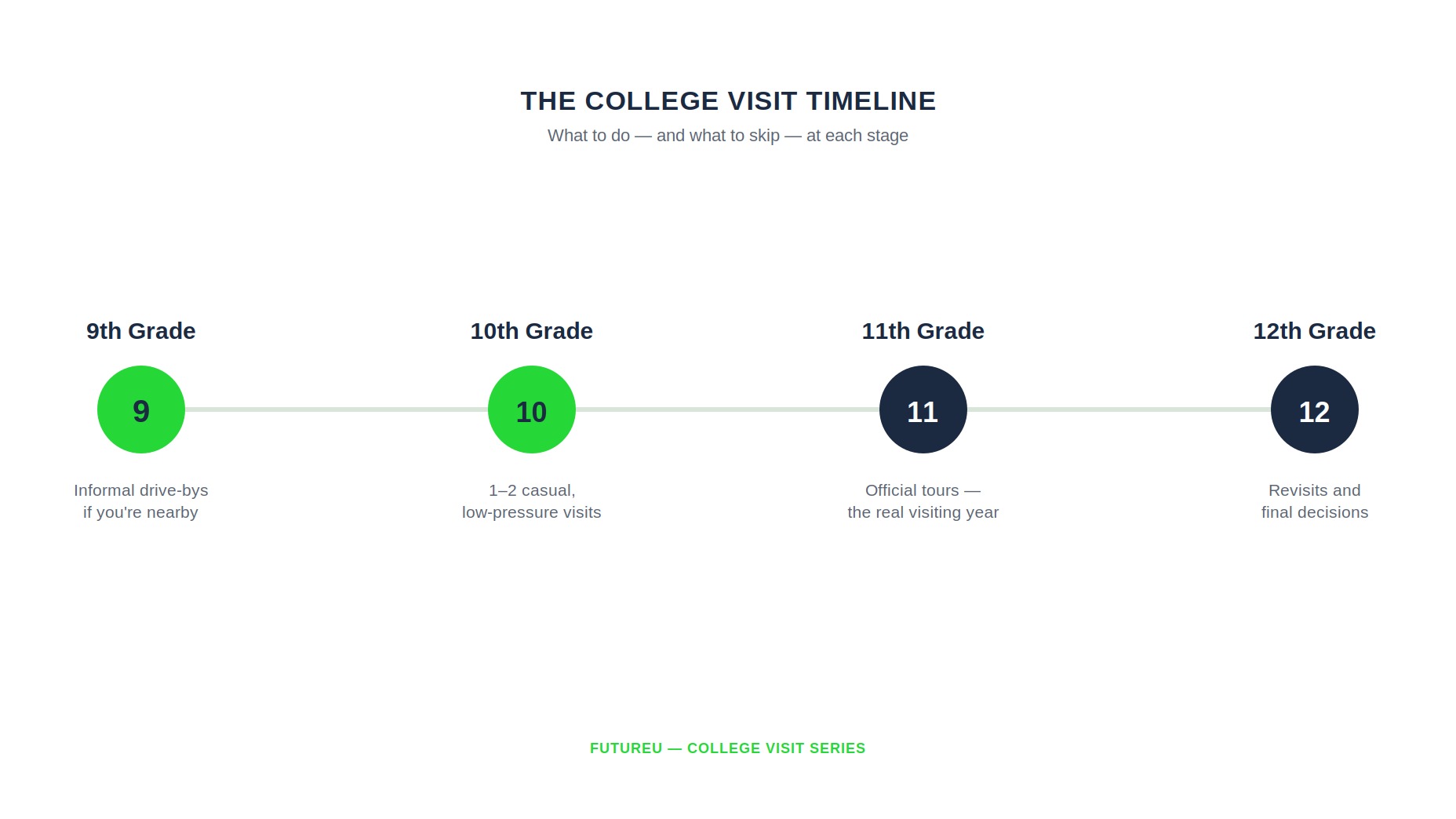
The Grade-by-Grade Timeline
|
Grade |
What to Do |
What Not to Do |
|---|---|---|
|
9th |
Informal "drive-bys" if you're near a campus anyway. Notice size and setting, nothing more. |
Don't schedule official tours yet — no need to add pressure this early. |
|
10th |
1–2 informal visits. Start building a sense of "type" — big vs. small, urban vs. rural, close to home vs. far. |
Don't expect a favorites list yet. This is about calibration, not decisions. |
|
11th |
Real visits — official tours, info sessions, the full question list. This is the serious visiting year. |
Don't wait until fall of senior year to do this for the first time — spots fill and time gets tight. |
|
12th |
Revisits to top contenders, plus any final financial aid conversations before deciding. |
This isn't the year for first looks — it's the year for narrowing and deciding. |
If you’re in the early exploration stage, our free Parent + Student College Visit Guides can help you turn casual campus visits into useful conversations without making the process feel bigger than it needs to be.
Why Starting Early Isn't About Getting Ahead
A 9th or 10th grader visiting a campus isn't trying to pick a school. They're building a reference point. A student who says "I don't want somewhere that big" after walking around one large campus has done real, useful work — even if they can't fully explain why yet. That instinct becomes much more useful in 11th grade, when the visits actually count toward a decision, because there's already a "type" to compare against instead of starting from zero.
Skipping straight to junior year visits isn't wrong, exactly — plenty of families do it and it works out fine. But it does mean the first few visits are doing double duty: building a sense of what the student even likes, and evaluating specific schools, at the same time. That's a lot to ask of one afternoon on one campus.
What "Informal" Actually Means in 9th and 10th Grade
Informal doesn't mean nothing — it means low-pressure. If you're already near a campus for another reason (a sports tournament, visiting family, a road trip), walk around for twenty minutes. Grab a coffee on campus. No tour registration, no info session, no pressure to have opinions ready. The goal is just noticing: does this feel like a place my student could picture themselves, or does it feel very clearly not that.
By 10th grade, one or two slightly more intentional visits — maybe an official tour, but skip the interview — starts to sharpen that sense of type without the weight of "this is a real decision visit."
The Junior Year Shift
11th grade is where this becomes real. This is the year for the full visit — registered ahead of time, real questions prepared, notes captured the same day. We share the most common mistakes families make once visits get serious in the next post of the series — the short version is: register early, bring a system for comparing, and don't skip the financial aid question. If you’re not sure what to ask, start with the parent and student question lists before your next visit. You can find it in 20 Questions to Ask on a College Visit: Parent and Student Lists.
Wherever You're Starting, Start There
College visits are one piece of a much bigger planning process, but they’re often the moment families realize they need a clearer system.
Which resource is right for where you are?
If you’re just starting to think about college visits:
Start with the free Parent + Student College Visit Guides. They’re designed to help families turn casual campus visits into useful conversations without making the process feel bigger than it needs to be.
If you have junior year visits coming up:
College Visit Kit Essentials gives you a simple system for preparing, comparing schools, and remembering what actually mattered after each visit.
If you want a more complete planning system:
College Visit Kit Pro is the better fit if you want more structure before, during, and after visits, especially if you’re comparing several schools or trying to make the most of limited time.
If you want ongoing guidance beyond college visits:
FutureU Academy is for families looking for a calmer, more guided path through the full college planning process.
Frequently Asked Questions
Is it too early to visit colleges in 9th grade?
No — informal, low-pressure visits in 9th grade are useful for building a sense of what kind of school setting appeals to a student, without any pressure to make decisions.
What grade should you start college tours?
Official tours and info sessions are typically most useful starting in 11th grade, once a student has some sense of what they're looking for. Informal visits can start earlier, in 9th or 10th grade.
How many college visits should a junior do?
There's no fixed number, but 11th grade is generally the year for the bulk of serious visiting — enough schools to compare real options, without so many that they start to blur together.
Keep going in the College Visit Series
If you’re planning visits now, these next posts can help you make each campus stop more useful.
If you’re getting ready for junior year visits:
Read 3 College Visit Mistakes Families Make and How to Avoid Them so you know what to avoid before you spend the time, money, and energy on campus tours.
If you want better questions to ask on campus:
Read 20 Questions to Ask on a College Visit: Parent and Student Lists before your next tour.
If you’ve already visited a few schools:
Read How to Compare Colleges After Campus Visits Without Losing Your Mind so the details don't blur together.
If cost is starting to feel confusing:
Read What Will College Actually Cost? How to Calculate Your Real Cost, Not the Sticker Price to start thinking beyond the published price.
Full College Visit Series
This post is part of FutureU’s College Visit Series, designed to help families plan campus visits with more clarity and less stress.
- When Should You Start Visiting Colleges? A Grade-by-Grade Guide (You’re here)
- 3 College Visit Mistakes Families Make and How to Avoid Them
- 20 Questions to Ask on a College Visit: Parent and Student Lists
- What to Do After a College Visit: A 5-Minute Checklist
- How to Compare Colleges After Campus Visits Without Losing Your Mind
- What Will College Actually Cost? How to Calculate Your Real Cost, Not the Sticker Price
Explore the full College Visit Planning Guide
Kathy LePage, PhD, is a Certified School Psychologist and Educational Consultant who helps families navigate big educational decisions with more clarity, confidence, and less stress. She supports families with college planning, educational and therapeutic placement, and support options for children, adolescents, and young adults — including building the real-world skills needed to live as independently as possible.
Get FutureU college planning updates
Practical tips for teens, parents, and educators on college, careers, and life after high school - plus updates on FutureU resources - delivered straight to your inbox.
We hate SPAM. We will never sell your information, for any reason.