
Can You Negotiate a Financial Aid Offer? 8 Questions Before May 1
Apr 17, 2026 Can You Negotiate a Financial Aid Offer? 8 Questions to Ask Before May 1
The short answer: you can ask for a financial aid review
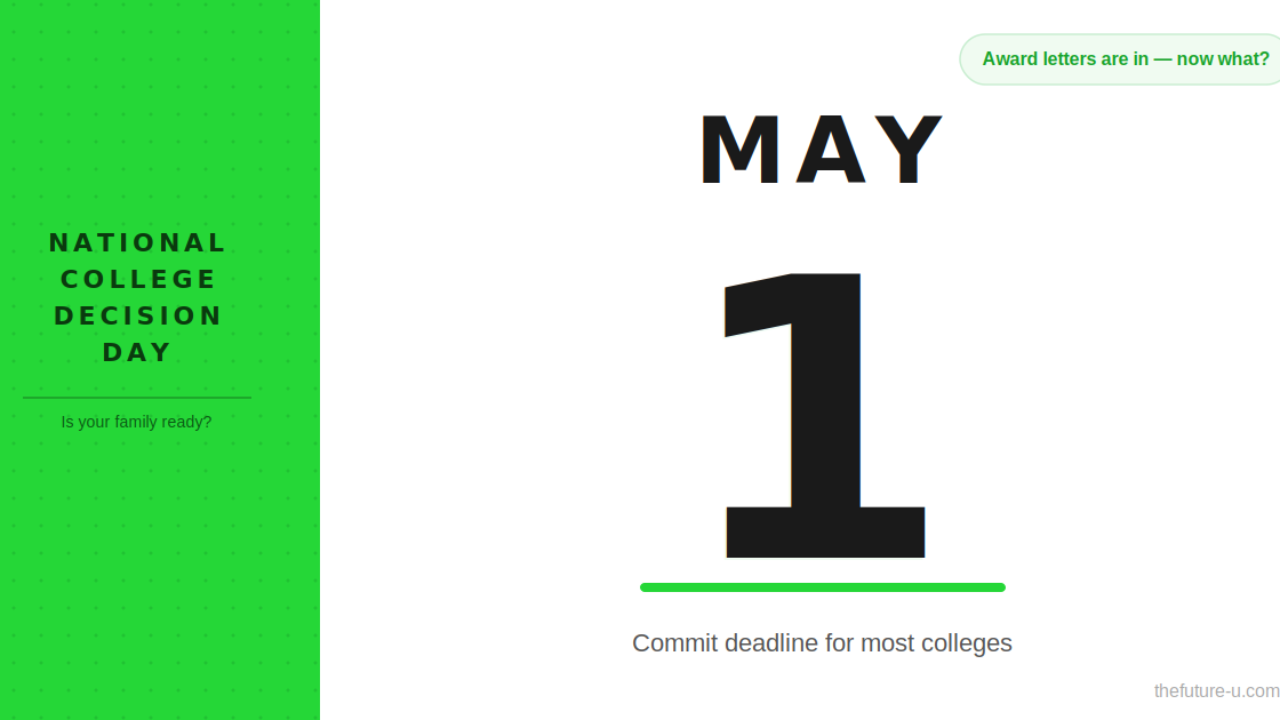
The financial aid letters have arrived. Your student has acceptances. May 1 is closer than it feels.
And if your house is like most families we talk to at FutureU, you're somewhere between cautiously optimistic and quietly overwhelmed — because the numbers in front of you raise more questions than they answer. That's completely normal.
Why financial aid offers are hard to compare
Award letters are not designed to be easy to read. They blend free money with debt, bury renewal conditions in fine print, and rarely tell you the one thing you most need to know: what you're actually committing to for four years, not just one.
The good news is that this moment — right now, before May 1 — is when families have the most leverage. You can still ask questions. You can still negotiate. You can still compare. Once you commit, most of those doors close.
Quick answer: Yes, families can ask a college to reconsider a financial aid offer, especially if their financial situation has changed, another school made a stronger offer, or the award letter is unclear. It is not a negotiation in the usual sense, and more aid is never guaranteed. But before committing, families can ask thoughtful questions, request a review, and compare the true four-year cost of each option.
8 questions to ask before accepting a financial aid offer
Below are the eight questions we hear most from families in exactly your position, with the honest answers that help you make a confident decision.
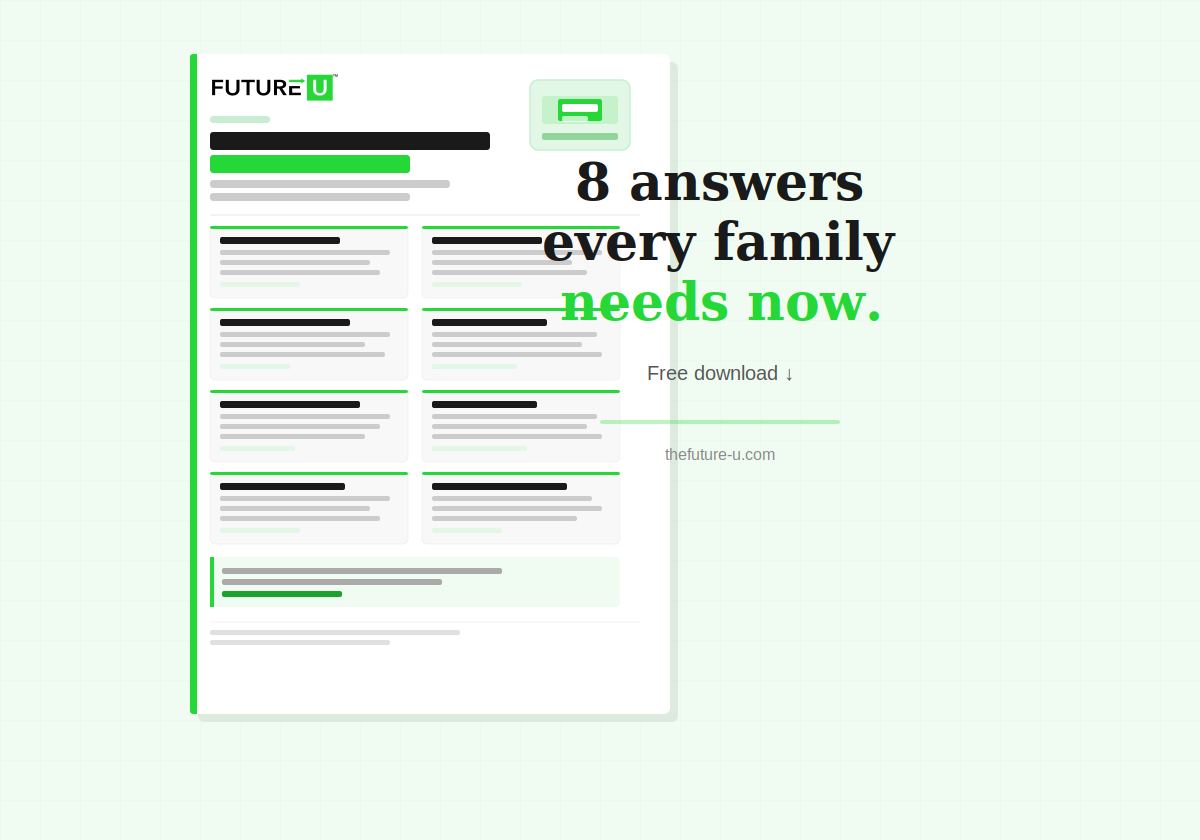
Want this as a printable one-pager to review with your student? Download the FutureU financial aid comparison guide here.
1. What's the difference between a grant, loan, and work-study in our award letter?
Grants and scholarships are free money — you never repay them. Loans are debt. Subsidized loans don't accrue interest while your student is enrolled; unsubsidized loans start accruing interest immediately. Work-study is available after a student is hired for a job and works the hours. Award letters often list grants, scholarships, both loan types and work-study on the same page without clearly distinguishing them, making packages look more generous than they are. Always separate free money from debt before comparing schools.
Tip: subtract only grants and scholarships to find your true net cost.
2. Can we negotiate a financial aid offer?
Short answer: Yes, you can ask a college to review a financial aid offer.
Families often do this when their financial circumstances have changed, when another college has offered more support, or when the original award does not reflect the family’s current ability to pay. The school may call this an appeal, reconsideration, professional judgment review, or special circumstances review.
If you've received a stronger offer from a comparable school, some financial aid offices will review their package. The process is sometimes is called a professional judgment appeal. A competing offer letter is your strongest leverage. Schools want to enroll your student and many have discretion to improve their offer. Private colleges are more likely to review their offer than large public universities or highly selective colleges.
Tip: be specific, be polite, and bring documentation.
3. Is this financial aid guaranteed for all four years?
Short answer: Not always. Some schools offer their most generous package in year one to attract students, then reduce it in subsequent years. Merit scholarships often carry renewal conditions — minimum GPA, credit hours, specific program enrollment — that aren't prominently disclosed. Always ask: "Is this package renewable, and under exactly what conditions?"
4. Do we have to accept everything in the financial aid package?
No. You can accept grants and scholarships, decline loans entirely, or accept partial loan amounts. Most families assume the package is all-or-nothing. It isn't. Never borrow more than you need simply because it was offered. Only take loans after accepting all free money and exhausting other resources.
5. Will an outside scholarship reduce school aid?
Short answer: Sometimes. This practice — called scholarship displacement — means some schools reduce their own institutional grants dollar-for-dollar when outside awards are added. The net cost stays the same, but the outside scholarship benefits the school, not your family. Always ask the aid office: "How do you apply outside scholarships to my package?"
6. How do we compare financial aid offers from different schools?
Short answer: Compare net cost, not sticker price, and not total aid. Net cost = Cost of Attendance minus all grants and scholarships only. Then ask whether that number holds for all four years. A school offering $30,000 in aid that includes $12,000 in loans is not the same as a school offering $30,000 in grants. The packaging can look identical and be very different.
7. Can we ask for more aid after receiving the offer?
Yes. If your family's financial situation has changed since you filed the FAFSA — job loss, medical expenses, divorce, a sibling starting college — you can request a professional judgment review. You can also appeal simply on the basis of a competing offer. Most families assume the number is final. It often isn't, especially if you ask before May 1.
8. What if the school our student loves costs more than we can manage?
Don't walk away before asking these questions: Has every form of aid been applied? Have we appealed? Is there a payment plan option? Are there departmental scholarships we haven't pursued? Is there a 4-year cost model that changes the picture? The answer may still be no — but most families give up before they've asked everything they should.
Before you commit, compare the full four-year cost
This is where a conversation with FutureU is worth the most.
Every one of these questions has a version that's specific to your family, your schools, and your offers — and the answers aren't always what you expect.
Get help comparing your student’s college offers
If you're working through award letters right now and want a clearer picture before May 1, FutureU coaches work one-on-one with families through exactly this process. Lower stress. Real clarity. Decisions you feel confident about.
Get help comparing your student’s college offers
Still unsure which offer makes the most sense? FutureU experts help families compare financial aid offers, understand the tradeoffs, and make a thoughtful college decision without panic.
If your family wants one-on-one guidance before committing, learn more about FutureU college planning support.
Frequently asked questions about financial aid offers
Can parents negotiate a college financial aid offer?
Families can ask a college to review or reconsider a financial aid offer. Some schools call this an appeal or special circumstances review. Additional aid is not guaranteed, but it is appropriate to ask clear, respectful questions before committing.
What is the best reason to appeal a financial aid offer?
Common reasons include a recent job loss, reduced income, medical expenses, a change in family circumstances, or a stronger competing offer from another college. The strongest appeals include documentation and a specific request.
Should families accept loans in a financial aid package?
Families do not have to accept every part of a financial aid package. Grants and scholarships usually do not need to be repaid, but loans do. Before accepting loans, compare the total four-year borrowing amount and monthly repayment estimate.
Can an outside scholarship reduce financial aid?
Yes, it can. Each college has its own outside scholarship policy. Ask whether the scholarship will reduce loans, work-study, or institutional grants before counting it as extra savings.
How should families compare two financial aid offers?
Compare net price, renewable aid, loan amounts, work-study expectations, housing and meal costs, travel costs, and likely cost increases over four years. Do not compare offers based only on the total award amount.
Get FutureU college planning updates
Practical tips for teens, parents, and educators on college, careers, and life after high school - plus updates on FutureU resources - delivered straight to your inbox.
We hate SPAM. We will never sell your information, for any reason.