

3 College Visit Mistakes Families Make and How to Avoid Them
Jul 21, 2026
Written by Kathy LePage, PhD, Certified School Psychologist & Educational Consultant — Helping families make thoughtful educational decisions with clarity and calm.
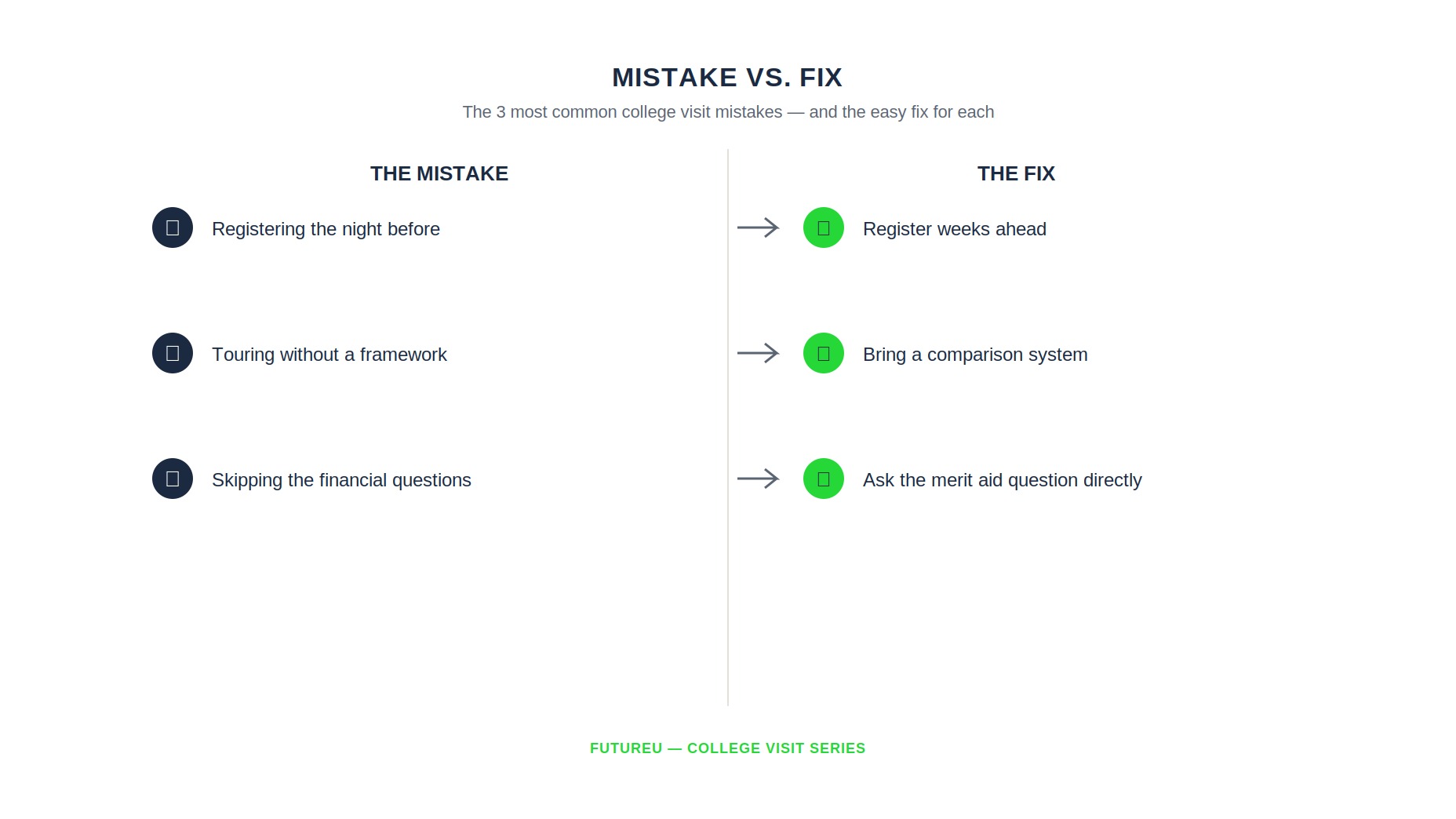
Quick answer: The three most common college visit mistakes are registering too late, touring without a way to compare schools, and skipping the financial aid questions. They cost families time, clarity, and money. Each one is fixable with a small change before your next visit.
This is the second post in FutureU’s College Visit Series. In the first post, we covered when to visit. Now we’re looking at how to make each visit count, so families don’t come home with a pile of brochures and no clearer direction. Coming up - questions to ask on visits, how to compare schools, and tips on how to think about college costs.
Also in this series:
- When Should You Start Visiting Colleges
- 20 Questions to Ask on a College Visit: Parent and Student Lists
- What to Do After a College Visit: 5-Minute Checklist
- How to Compare Colleges After Campus Visits Without Losing Your Mind
- What Will College Actually Cost? How to Compare Your Real Cost, Not the Sticker Price
Here's how most college visits go.
You drive two or three hours. You pay for gas, maybe a hotel. You sit through the info session, take the tour, snap some photos in front of the quad. Your student says it was "nice" or "big" or "kind of what I expected." You drive home and realize you're not sure you learned anything you couldn't have found on the website.
You're not alone. This is how the majority of college visits go — and it's not your fault. Nobody teaches families how to visit colleges strategically. You're just kind of... dropped in.
That changes today.
The Three Things Most Families Miss on a College Visit
1. They don't register early enough.
Info sessions and official tours fill up weeks in advance. Showing up last-minute means you might not get in — and worse, you miss the chance to signal demonstrated interest. At many schools, registering for a visit is tracked by admissions. At some colleges, visit registration is also one way a student shows demonstrated interest, so it's worth planning ahead. Waiting until the night before is one of the most common and most avoidable mistakes we see.
2. They tour without a framework.
After visiting three or four colleges in a row, they all start to blur. Students can't tell you which school had the dining hall they liked or which one had the professor they talked to. Without a system for capturing impressions in real time, you're left with vague memories instead of data. Not helpful for making a college decision.
3. They skip the financial questions.
The question every family should ask:
"What percentage of students receive merit scholarships — and what GPA or test score is typically required to qualify?"
Most admissions counselors will answer this directly. The families who ask walk away with real information. The families who don't often get to April of senior year and realize the school they fell in love with costs $20,000 more per year than they planned.
If you want a fuller list of what to ask on campus, including questions for both parents and students, read 20 Questions to Ask on a College Visit: Parent and Student Lists.
Most families don't factor in the increasing cost of college. According to College Board's Trends in College Pricing and Student Aid 2025 report, average published tuition and fees for 2025-26 rose 2.9% at public four-year in-state institutions and 4.0% at private nonprofit four-year colleges — which is exactly why the number you hear on a Year 1 tour isn't the only number your family should be planning around. (Full report)
Here’s a simple way to think about what to check before, during, and after each visit.
What a Strategic Visit Actually Looks Like
A strategic visit has three phases:
- Before — registered weeks in advance, specific questions prepared, college map reviewed
- During — vibe check, major's building visit, dining hall test, asking what only a real student would know
- After — gut feeling rated 1–10 immediately, three things liked, one thing uncertain, notes captured before the schools blur; parent and student write down thoughts
It's also a financial conversation. What's the sticker price? What's the net cost after merit aid? What does four years actually cost when you factor in annual tuition increases? The difference between those numbers can be staggering — and most families don't do that math until it's too late to use it.
Before your next college visit, do three things:
- Register early, ideally a few weeks ahead.
- Choose 3 questions you want answered before you arrive. If you need a starting point, use the parent and student question lists in 20 Questions to Ask on a College Visit: Parent and Student Lists.
- Both the student and parent write down impressions the same day, before the schools blur together.
A Simple System Makes College Visits More Useful
Families don’t need a complicated planning system. They need a simple way to prepare before the visit, notice what matters during the visit, and compare schools afterward while the details are still fresh. One of the easiest ways to avoid a wasted trip is to decide your questions to ask on a college visit before you arrive.
The FutureU College Visit Kits are spreadsheet–based trackers designed to take the chaos out of college visits and put real, comparable data in front of your family. Both are available on our Digital Resources Page.
If you’re visiting a few schools and need a simple way to compare them:
College Visit Kit Essentials gives you the core comparison tracker so the schools don’t blur together.
If you’re comparing several schools or trying to understand the financial side clearly:
College Visit Kit Pro adds deeper planning worksheets, financial aid comparison, year-by-year cost projections, and a loan reality check.
The Essentials Kit is delivered as a Google Sheet, and the Pro Kit is delivered as a file compatible with Excel or Google Sheets. You can access them anywhere, and fill them in on your phone in the car on the way home from the visit. No printing required. No lost papers.
If you’re not ready for a kit yet:
Start with the free Parent + Student College Visit Guides. They’ll help you ask better questions and notice what matters. One page for parents. One page for students.
The Visit Isn't About Falling in Love
Here's the mindset shift that changes everything: the goal of a college visit is not to find The One. It's to gather real information so your family can make a real decision.
Sometimes the most useful visit is the one where your student says "nope — not for me." That's the list getting better. That's the process working.
College planning shouldn't spike your anxiety. It should lower it. That's what we're here for.
Frequently Asked Questions
What's the biggest mistake families make on college visits?
The single biggest mistake is skipping the financial aid question — specifically, not asking what percentage of students receive merit aid and what it typically takes to qualify. Families who ask this question walk away with real numbers instead of assumptions.
How far in advance should you register for a college visit?
Register at least a few weeks ahead whenever possible. Info sessions and official tours fill up, and at many schools your registration itself is tracked as a sign of demonstrated interest.
Do I need a college visit checklist?
A checklist can help you compare schools more clearly, especially once visits move from casual exploration to serious junior-year planning. After visiting 3 or more campuses, they start to blur together.
What financial question should every family ask on a college visit?
Ask directly: "What percentage of students receive merit scholarships, and what GPA or test score is typically required to qualify?" Most admissions counselors will answer this on the spot.
Get the College Visit Kit through our digital resources page before your next campus tour, so your family can compare schools clearly while the details are still fresh.
And if you want support beyond college visits, FutureU Academy helps families navigate the broader college planning process with more structure, clarity, and calm.
Full College Visit Series
This post is part of FutureU’s College Visit Series, designed to help families plan campus visits with more clarity and less stress.
- When Should You Start Visiting Colleges? A Grade-by-Grade Guide
- 3 College Visit Mistakes Families Make and How to Avoid Them (You’re here)
- 20 Questions to Ask on a College Visit: Parent and Student Lists
- What to Do After a College Visit: A 5-Minute Checklist
- How to Compare Colleges After Campus Visits Without Losing Your Mind
- What Will College Actually Cost? How to Calculate Your Real Cost, Not the Sticker Price
Explore the full College Visit Planning Guide
Kathy LePage, PhD, is a Certified School Psychologist and Educational Consultant who helps families navigate big educational decisions with more clarity, confidence, and less stress. She supports families with college planning, educational and therapeutic placement, and support options for children, adolescents, and young adults — including building the real-world skills needed to live as independently as possible.
Get FutureU college planning updates
Practical tips for teens, parents, and educators on college, careers, and life after high school - plus updates on FutureU resources - delivered straight to your inbox.
We hate SPAM. We will never sell your information, for any reason.