
FERPA and Common App Recommendations: What Students Need to Know
Sep 28, 2026The FERPA question in Common App can make families nervous because it sounds legal and permanent. Many students worry that choosing the wrong option will hurt their application or prevent them from seeing recommendation letters later.
By Sarah Bowen, Founder of FutureU
The good news: the basic idea is simpler than it looks.
Quick answer
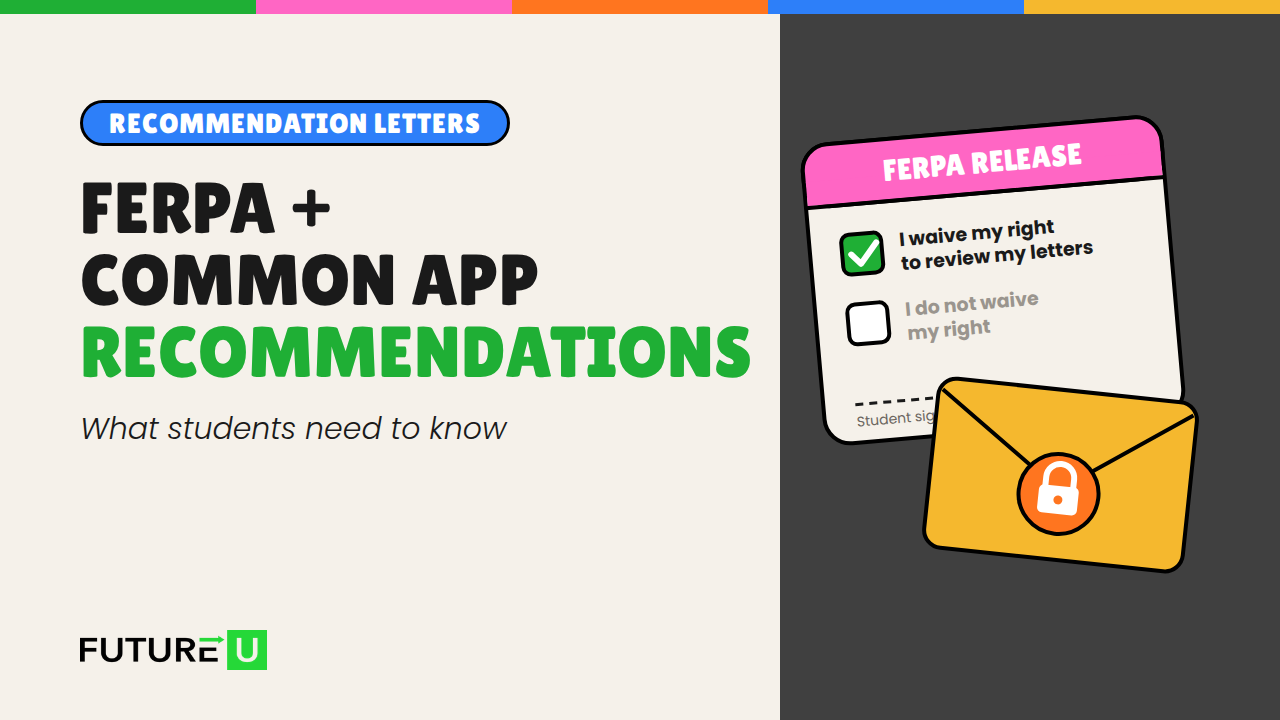
FERPA is a federal privacy law related to student education records. In Common App, students are asked whether they waive their right to access recommendation letters after they enroll at a college.
Many students waive this right because it signals that recommenders can write candidly. Students who are unsure should read the language carefully and ask their school counselor for guidance.
If your student is navigating recommendation requests, the free Ask With Confidence: Letter of Recommendation Starter Guide can help them ask clearly and stay organized. The Ask With Confidence: College Letter of Recommendation Guide includes templates, examples, and planning checklists for the whole process.
What is FERPA?
FERPA stands for the Family Educational Rights and Privacy Act. It gives students certain rights related to education records.
In the college application process, FERPA usually comes up when a student is inviting counselors and teachers to submit school forms or recommendation letters.
The Common App asks students to make a choice about whether they waive their right to review those recommendations later, after enrolling at a college.
What does it mean to waive FERPA rights?
When students waive their right, they are saying they do not plan to access those recommendation letters later.
This does not mean the student loses control of the application. It simply means the letters are intended to be confidential between the recommender and the colleges receiving them.
Many colleges and counselors view waived letters as more candid because the recommender knows the student will not read the letter later.
What if a student does not waive FERPA rights?
If a student does not waive the right, it means they may be able to request access to certain recommendation letters after enrolling at a college, depending on the college’s policies and record retention.
It does not automatically mean an application will be rejected. However, some recommenders may feel less comfortable writing candidly if the letter is not confidential.
Students should not guess. If they are unsure, they should ask their counselor before making the selection.
Can students change the FERPA waiver later?
Students should treat the FERPA waiver as an important choice and read carefully before submitting it. In Common App, changes can be limited once recommenders have been invited.
Because details can vary by platform and timing, students should check the current Common App instructions and ask their school counselor if they have questions.
Where does FERPA appear in Common App?
FERPA appears in the recommendation section of Common App, before students invite recommenders. Students usually need to complete the FERPA release before teacher or counselor invitations can be sent.
This is one reason students should slow down and understand the choice before clicking through.
What should students do before inviting recommenders?
Before inviting recommenders in Common App, students should confirm each college’s requirements, ask teachers directly, prepare basic materials, and read the FERPA release carefully.
Students should not use the platform invitation as the first time a teacher learns they are being asked for a letter. The respectful approach is to ask the teacher first, then send the official invitation once the teacher has agreed.
The Ask With Confidence: College Letter of Recommendation Guide walks students through the full order of operations so they know what to do before, during, and after sending invitations.
How many recommendation letters do colleges need?
Requirements vary. Some colleges require one teacher recommendation, some require two, and some do not require any. Certain programs may have additional requirements.
Students should check each college’s admissions website and Common App requirements instead of assuming every school wants the same number of letters.
More is not always better. Extra letters should only be sent when allowed and when they add something meaningful.
Who should students invite in Common App?
Students should invite teachers who have already agreed to write and who can speak with detail about their academic work, growth, character, or classroom contribution.
Fit matters more than prestige. A teacher who knows the student well can often write a stronger letter than someone with an impressive title but limited personal knowledge.
What if a recommender has not submitted yet?
First, students should check the actual deadline and the recommender status. Many teachers submit letters close to the deadline, especially during busy application seasons.
If a reminder is appropriate, it should be brief, polite, and appreciative. Students should avoid sounding demanding or panicked.
The Ask With Confidence: College Letter of Recommendation Guide includes reminder wording, follow-up timing, and troubleshooting steps for missing or delayed recommendations.
Common mistakes to avoid
Students should watch out for a few common issues:
- Clicking through the FERPA release without reading it
- Inviting a teacher before asking them directly
- Assuming every college has the same recommendation requirements
- Waiting too long to request letters
- Sending disorganized or incomplete information
- Forgetting to monitor application portals and deadlines
These mistakes are avoidable with a clear plan.
What parents should know
Parents can help students stay organized, but students should manage the recommender relationship themselves.
Parents can support by helping track deadlines, reminding the student to read instructions carefully, and encouraging the student to ask the school counselor when something is unclear.
Parents should avoid emailing teachers on the student’s behalf unless there is a specific school-approved reason.
FERPA FAQ
Does waiving FERPA mean I cannot see my application?
No. The waiver is about access to recommendation letters later, not whether the student can view their own application materials while applying.
Does waiving FERPA guarantee a better letter?
No. A strong letter depends on the recommender’s knowledge of the student. Waiving the right simply supports confidentiality.
Should every student waive FERPA?
Many students do, but students should make an informed choice. If they are unsure, they should ask their counselor.
Is FERPA the same as asking for a recommendation?
No. FERPA is the privacy waiver. Asking for a recommendation is a separate step that should happen before sending the official invitation.
Final thought
The FERPA section of Common App is important, but it does not need to be scary. Students should read the release carefully, ask teachers before inviting them, and check each college’s requirements.
The free Ask With Confidence: Letter of Recommendation Starter Guide gives students a clear, respectful, specific framework, one starter script, a 3-point check before sending, and a short parent note for the first recommendation request.
The Ask With Confidence: College Letter of Recommendation Guide includes the complete recommendation workflow, FERPA and Common App decision support, deadlines and materials planning, follow-up language, reminder wording, and troubleshooting checklists for the full process.
Want help asking for a recommendation letter the right way?
Start with the free Ask With Confidence: Letter of Recommendation Starter Guide. It gives students a clear, respectful way to ask, plus a simple framework for what to include before they reach out.
If you want the full set of templates and examples, get the Ask With Confidence: College Letter of Recommendation Guide.
Keep reading
- How to Ask for a College Recommendation Letter
- What to Put in a Brag Sheet for a Recommendation Letter
About the Author
Sarah Bowen is the founder of FutureU, where she helps families navigate college planning, recommendation requests, and the transition to college with more clarity and less stress. FutureU resources are designed to help students take ownership of the process while giving parents a calmer way to support them.
Get FutureU college planning updates
Practical tips for teens, parents, and educators on college, careers, and life after high school - plus updates on FutureU resources - delivered straight to your inbox.
We hate SPAM. We will never sell your information, for any reason.