
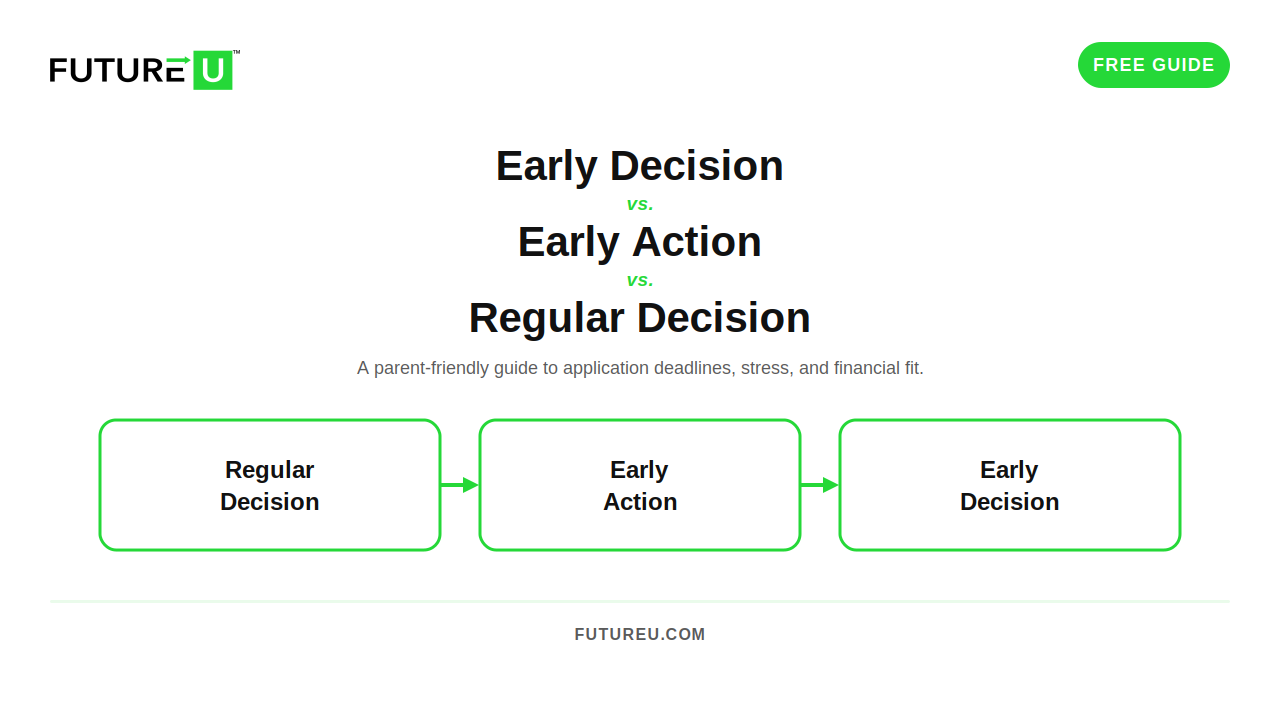
Early Action vs. Early Decision vs. Regular Decision: How to Choose
Aug 22, 2026FutureU is one of the only college planning practices in the country led by licensed mental health professionals—so we don't just look at deadlines and odds. We look at what this decision actually does to your kid and your family along the way.
Quick answer: Early Action is early and non-binding, Early Decision is early and binding, and Regular Decision gives families the most time and flexibility. The right choice depends on whether your student has a true first-choice school, whether your family needs to compare financial aid offers, and whether an early answer would lower stress or add pressure.f you've started hearing these three phrases tossed around at back-to-school night, in your group chat, or from your student's friend who "already knows exactly where they're applying"—and you're feeling behind—let's pause right here.
You're not behind. You're just new to the vocabulary.
Early Action, Early Decision, and Regular Decision are just three different doors into the same building. None of them make your kid smarter, more driven, or more "ahead" than the next kid. They're logistics, not a character judgment. So let's break down what each one actually means, who it's for, and how to pick without spiraling.
Want the simple side-by-side version? Download the free EA/ED/RD decision guide.
Why these deadlines feel bigger than logistics
Colleges use these different deadlines to manage enrollment and predict their incoming class. That's it. That's the whole secret. It's a numbers game on their end—which means your job is to understand the rules of the game, not to guess your way through it.
Here's the part most breakdowns skip: certainty and ambiguity affect stress differently depending on the kid. Some teens' anxiety comes from not knowing—for them, a binding "yes" can genuinely lower stress, because the decision is closed and they can stop carrying it. Other teens' anxiety comes from feeling locked in—for them, that same binding "yes" can spike panic, because there's no longer an exit if doubt creeps in later. Neither reaction is wrong. But it means the "right" application strategy isn't just about the school—it's about which kind of stress your particular kid handles better.
The Three Doors, Explained
Each application plan answers a different question: how much time does your student need, how much flexibility does your family need, and how ready are you to make a commitment?
Regular Decision
Binding? No
Typical deadline: January
Best for: Students still comparing options
Watch out for: The wait can feel long if the list stays broad.
Regular Decision gives your student the most time and flexibility. It is often the best fit when your student is still narrowing the list, wants senior fall grades to strengthen the application, or needs to compare financial aid offers before choosing.
Early Action
Binding? No
Typical deadline: November
Best for: Students who want an early answer without committing
Watch out for: Some schools have restrictive Early Action rules.
Early Action lets your student apply early and hear back sooner without committing to attend. For many families, it lowers stress because there may be an answer before winter break, while still preserving the ability to compare options later.
Early Decision
Binding? Yes
Typical deadline: November
Best for: Students with a true first choice and clear financial fit
Watch out for: Families usually cannot compare aid offers.
Early Decision is different because it is binding. If your student is accepted and the financial fit works, they are expected to attend. ED only makes sense when the school is a true first choice and your family does not need to compare financial aid offers.
So Which One Should Your Student Choose?
Here's the honest version, not the vague version:
- Choose RD if: Your student is still exploring, wants more time, or needs fall semester grades to strengthen the application.
- Choose EA if: Your student wants an early answer and to reduce senior-year anxiety, without giving up flexibility or the ability to compare aid.
- Choose ED if: There's one clear favorite school, your student has visited (in person or virtually), and your family is confident about affordability without needing to shop offers.
Totally normal to feel unsure right now. Most families do. The goal isn't picking the "impressive" option—it's picking the right fit option.
One more thing worth naming: this decision rarely happens in a vacuum. If there's pressure in your house right now—comparison with a sibling, a neighbor's kid, or "what will people think"—that pressure will leak into which door your student picks, whether anyone means for it to or not. The strategy question ("RD, EA, or ED?") is actually downstream of a relationship question: is this choice coming from my kid, or from the noise around my kid?
Ask These Questions Before Choosing ED, EA, or RD
Instead of doom-scrolling admissions forums at midnight, sit down with your student and ask:
- Do we know our top choice, or are we still exploring? (Exploring → RD or EA. Certain → ED is on the table.)
- Do we need to compare financial aid offers? (Yes → avoid ED. It removes that option.)
- Would an early answer lower our stress or add pressure? (Be honest here—some students thrive with an early yes/no; others do better with more runway.)
Free family guide: Early Decision vs Early Action vs Regular Decision
Get the 2-minute breakdown, comparison chart, and three decision-check questions to help your family choose the right application path.
When to Ask for Help
If your student is stuck between "I think I know" and "but what if," that's not a red flag—that's a normal 11th or 12th grade Tuesday. This is exactly the kind of decision that benefits from an outside, non-anxious set of eyes: someone who isn't emotionally tangled up in the outcome the way parents (understandably) are.
Instead Of / Try
| Instead of saying... | Try saying... |
|---|---|
| “You need to just pick a school already.” | “Let’s map out what fits before we lock anything in.” |
| “Everyone else already knows where they’re applying.” | “Every family’s timeline looks different. Let’s figure out ours.” |
Frequently Asked Questions
Is Early Decision binding?
Yes. Early Decision is binding if the student is accepted and the financial aid package works for the family. Students should only apply ED if the school is a true first choice and the family is comfortable with the likely cost.
Can you compare financial aid offers with Early Decision?
Usually, no. Early Decision limits your ability to compare financial aid offers because the student is expected to attend if accepted.
Is Early Action better than Regular Decision?
Early Action can be helpful if the application is ready and an early answer would lower stress. Regular Decision may be better if the student needs more time, stronger senior-year grades, or more space to compare options.
Can students apply Early Action to more than one college?
Usually, yes. Most Early Action plans are non-binding, but some colleges offer restrictive or single-choice Early Action, so families should always check each school’s rules.
Which application plan is best for anxious students?
It depends on the type of anxiety. Some students feel better with an early answer, while others feel more pressure when decisions are rushed or binding. The right plan should fit the student’s readiness, finances, and stress level.
Keep this guide handy
You don't have to sort through application options from memory or late-night search results. Download the free guide so your family can compare the options, talk through the financial tradeoffs, and choose the timeline that actually fits your student.
Download the free Early Decision vs Early Action vs Regular Decision guide
If this deadline decision is part of a bigger planning process, FutureU Academy offers broader support for families who want grade-specific roadmaps, tools, and live support as they move through college planning.
And if your student hasn't even landed on a list yet, that's a different (earlier) kind of stuck—our College & Trade School Search support is built for exactly that "let's just sit down and figure out the fit" stage.
College planning doesn't start senior year. That's when it ends. Let's start now.
Get FutureU college planning updates
Practical tips for teens, parents, and educators on college, careers, and life after high school - plus updates on FutureU resources - delivered straight to your inbox.
We hate SPAM. We will never sell your information, for any reason.